


Weaning charts are mostly written in a way that leaves you feeling behind. This piece is written differently: by stage, with signs you can actually see at home, and a clear line between what is essential and what is merely nice to have.
Every child has their own pace. The stages below are a framework, not a timetable. If your child has a medical condition, allergies or is growing slowly, always discuss their diet with your paediatrician or health visitor.
6–8 months: first tastes
At this stage milk — breast or formula — remains the main source of food. Everything else is practice. Your child is learning to swallow thicker food, to cope with new tastes and to take part in the meal.
What is worth offering
- Simple, soft foods: cooked carrot, sweet potato, banana, avocado, cooked apple.
- Thicker purées with no sugar and no salt.
- Elongated pieces, big enough for your child to hold in a fist.
What isn’t needed yet
- Salt and sugar — not at this stage, and not for a long time after.
- Variety at any cost. A few foods your child knows well beat twenty experiments.
- Separate “children’s” meals at a different time. Wherever possible, your child should eat when you eat.
The signs that your child is ready for this step at all are listed in seven signs your child is ready to eat on their own.
8–12 months: the pincer grip
Somewhere in this window the pincer grip appears — thumb and index finger together. That is a big change: your child can pick up small pieces and take them deliberately to their mouth. Meals become more independent and a good deal messier.
This is where tableware first genuinely gets used. As long as your child was eating from a spoon in your hand, the plate was mostly scenery. Now it becomes a tool — and the difference between a plate that holds and one that doesn’t shows up every single day.
- Offer two or three different textures in the same meal.
- Let your child touch the food, even when they don’t eat it.
- Introduce a cup of water with the meal — not after it.
12–18 months: the spoon and a will of their own
Your child starts trying the spoon. For the first few months more food will land somewhere other than in their mouth, and that is a normal part of learning. At the same time something appears that often catches parents off guard: refusal.
A child who has eaten everything so far suddenly won’t touch what they adored last week. This isn’t fussiness in the real sense of the word, it is a developmental stage — your child is testing where they get a say. How to handle it without turning the meal into a negotiation, we described in a fussy eater and a plate with compartments.
Two spoons beat one: your child holds one, and you help with the other when needed. That way you aren’t taking control away, and the meal doesn’t last forty minutes.
18–24 months: your child at the family table
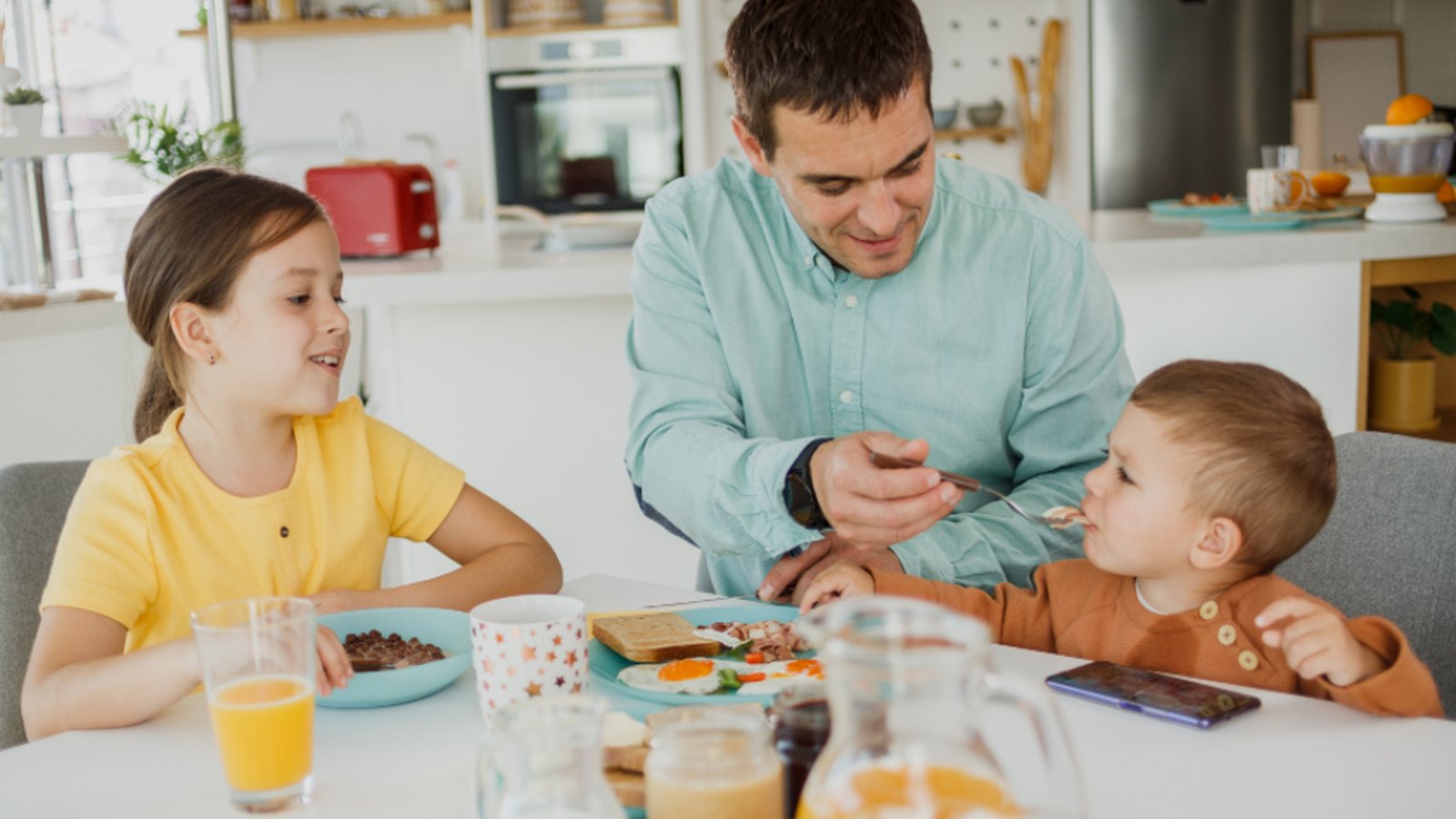
The goal of the whole weaning process is simple: your child eats what you eat, just in a different quantity and shape. If you got this far by having them sit with you at the table, it happens almost by itself.
- The same meal as everyone else, cut into smaller pieces if needed.
- Your child serves themselves from the shared bowl — even if it is slow.
- Less commentary about food at the table, praise as much as criticism.
What you actually need across all these stages
Adding it up: a stable high chair, tableware that doesn’t move, a soft spoon and patience. The kit changes across the stages more in shape than in quantity — a bowl to begin with, a plate with compartments once your child starts eating with their fingers, a cup once they drink on their own.
Which set suits which stage, we summed up in the guide by age.
The three commonest sources of guilt — and what actually holds
“The neighbour’s child was eating everything at eight months.”
The range is enormous. Children who start more slowly usually catch up with their peers by the age of two. Comparing children tells you very little.
“They eat too little.”
A toddler’s appetite swings over days and weeks, not over individual meals. What your child eats across a week matters more than any single day.
“They have to finish the plate.”
Children have a well-developed sense of fullness. Pushing them to eat damages it — that is one of the few things about feeding where the evidence genuinely agrees.